

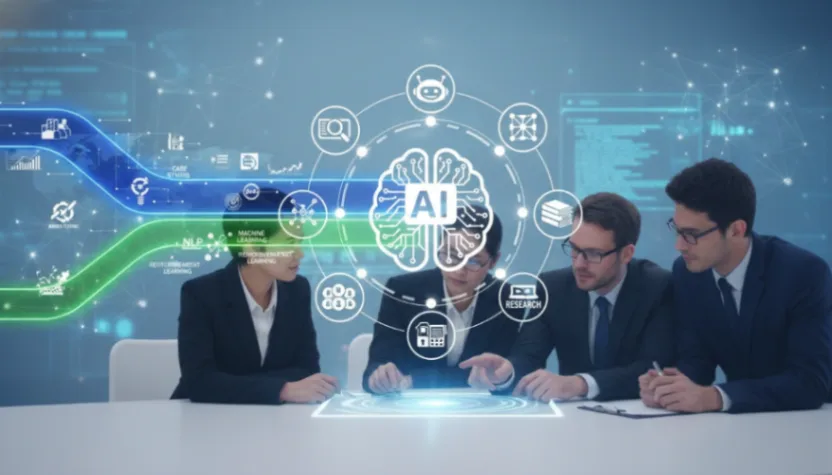
Artificial intelligence is no longer limited to chatbots or predictive analytics. Modern AI agents are transforming how businesses operate by automating complex workflows, making intelligent decisions, interacting with multiple systems, and executing tasks with minimal human intervention. These advanced software entities can understand context, reason through problems, access enterprise data, and perform actions across business applications.
Organizations across industries such as healthcare, finance, manufacturing, retail, logistics, and SaaS are increasingly investing in AI agent development services to improve efficiency, reduce operational costs, and create better customer experiences. Whether it is an AI-powered customer support assistant, an autonomous sales agent, a procurement automation system, or an enterprise knowledge assistant, AI agents are becoming critical business assets. Businesses exploring AI adoption often begin by understanding artificial intelligence and how modern AI systems drive measurable business outcomes.
The growing demand for AI solutions has led to a rapid increase in AI development companies offering agent development services. However, not every provider possesses the expertise, technical capabilities, and industry knowledge required to build enterprise-grade AI systems. Choosing the right AI agent development company can determine whether your AI initiative delivers measurable business value or becomes an expensive experiment.
This guide explores the key considerations organizations should evaluate when selecting an AI agent development partner and explains how businesses can make informed decisions that support long-term success.
Why Choosing the Right AI Agent Development Company Matters
AI agent development is significantly more complex than traditional software development. It requires expertise in artificial intelligence, machine learning, large language models, natural language processing, data engineering, cloud infrastructure, API integrations, security frameworks, and enterprise architecture.
The right development company helps organizations move beyond proof-of-concept projects and build scalable solutions that generate real business outcomes. A capable partner understands how to align AI initiatives with operational goals, user requirements, compliance obligations, and long-term growth strategies.
For example, a manufacturing company implementing AI agents for predictive maintenance requires entirely different expertise than a financial institution deploying AI assistants for customer onboarding and risk analysis. The development partner must understand both the technology and the industry context.
Choosing the wrong company can result in poor model performance, security vulnerabilities, integration challenges, missed deadlines, budget overruns, and low user adoption. Conversely, selecting the right partner can accelerate innovation, improve operational efficiency, and create sustainable competitive advantages.
What is an AI Agent Development Company?
An AI agent development company specializes in designing, building, deploying, and maintaining intelligent software agents capable of performing tasks autonomously. These companies combine expertise in AI technologies with software engineering practices to create solutions that can interact with users, process information, make decisions, and execute actions.
Unlike traditional software vendors that focus solely on application development, AI agent development companies work with advanced technologies such as large language models (LLMs), retrieval-augmented generation (RAG), vector databases, machine learning algorithms, agent orchestration frameworks, and enterprise automation systems. Organizations comparing service providers can explore leading AI development companies to better understand the AI services landscape.
Depending on business requirements, these companies may develop customer support AI agents, enterprise knowledge assistants, sales and marketing automation agents, HR and recruitment assistants, financial analysis agents, supply chain optimization systems, IT support agents, and healthcare workflow automation platforms.
Their role extends beyond development to include consulting, architecture design, deployment, governance, optimization, and ongoing maintenance.
Understanding Your Business Goals and AI Requirements
Before evaluating potential development partners, organizations must clearly define their objectives. One of the most common reasons AI projects fail is the absence of well-defined business goals.
Rather than starting with technology selection, businesses should focus on identifying the problems they want to solve.
Questions to consider include:
What business processes require automation?
What operational bottlenecks currently exist?
Which departments will use the AI agent?
What systems must the AI agent integrate with?
What measurable outcomes are expected?
How will success be evaluated?
For example, an enterprise may want an AI customer service agent capable of resolving 70% of support inquiries without human intervention. Another organization may seek an internal knowledge management agent that reduces employee search time by 50%.
Businesses that are new to enterprise technology implementation may also benefit from understanding custom software development before evaluating AI agent development vendors.
Clearly documenting these requirements enables more effective vendor evaluations and helps development partners propose relevant solutions.
Key Factors to Consider When Evaluating AI Development Partners
Choosing an AI agent development company should involve a comprehensive evaluation process rather than relying solely on marketing claims or pricing comparisons.
Key evaluation areas include industry expertise, technical capabilities, AI framework knowledge, integration experience, security practices, scalability capabilities, project management approach, communication standards, support and maintenance services, and pricing transparency.
Businesses should create a structured vendor assessment framework and compare providers using consistent criteria. Many of the same principles apply when finding the right software development company for your business.
Assessing Industry Experience and Domain Expertise
Technical skills alone are not enough to guarantee successful AI implementation. Industry expertise plays a significant role in determining project outcomes.
Development companies with experience in your industry understand business workflows, regulatory requirements, compliance obligations, customer expectations, and operational challenges. This knowledge allows them to build AI agents that align more closely with real-world business needs.
For instance, healthcare organizations require AI systems capable of handling sensitive patient information while complying with privacy regulations. Financial institutions require robust audit trails, fraud detection capabilities, and risk management controls.
Ask vendors about relevant industry projects, business outcomes achieved, industry-specific challenges solved, regulatory experience, and enterprise deployment examples.
Companies with proven industry expertise typically deliver faster implementation timelines and better long-term results. Similar evaluation criteria are discussed when comparing leading software development companies.
Evaluating Technical Capabilities and AI Technologies
The AI technology landscape evolves rapidly. Development partners should demonstrate expertise across a broad range of technologies rather than relying on a single platform or framework.
Areas of expertise should include large language models, natural language processing, deep learning, retrieval-augmented generation, vector databases, knowledge graph integration, cloud-native deployment, API orchestration, and enterprise system integration.
The company should also demonstrate the ability to select the most appropriate technologies based on business objectives rather than simply following industry trends.
Organizations that want a deeper understanding of foundational AI technologies can explore machine learning and how it powers modern intelligent systems.
Reviewing AI Agent Development Frameworks and Tech Stack
The framework and technology stack used to build AI agents directly impact performance, scalability, maintainability, and future expansion. Organizations should understand the tools and platforms a vendor uses before making a decision.
Modern AI agents are commonly built using large language models, orchestration frameworks, vector databases, retrieval systems, cloud infrastructure, and enterprise APIs.
A qualified development company should explain how its architecture supports context retention, memory management, multi-agent collaboration, real-time decision-making, external tool integration, data retrieval, and knowledge management.
Companies that follow modern software architecture principles typically build more reliable and future-proof solutions. Businesses evaluating technical partners may also benefit from understanding software architecture best practices when assessing proposed AI systems.
Reviewing AI Agent Development Frameworks and Tech Stack
The framework and technology stack used to build AI agents directly impact performance, scalability, maintainability, and future expansion. Organizations should understand the tools and platforms a vendor uses before making a decision.
Modern AI agents are commonly built using large language models, orchestration frameworks, vector databases, retrieval systems, cloud infrastructure, and enterprise APIs.
A qualified development company should explain how its architecture supports:
• Context retention and memory management
• Multi-agent collaboration
• Real-time decision-making
• External tool integration
• Data retrieval and knowledge management
• Performance monitoring and optimization
Companies that follow modern software architecture principles typically build more reliable and future-proof solutions. Businesses evaluating technical partners may also benefit from understanding software architecture best practices when assessing proposed AI systems.
Importance of Custom AI Agent Development Solutions
Every business has unique processes, workflows, data structures, and operational requirements. Generic AI tools often provide limited value because they cannot fully adapt to specific business needs.
Custom AI agent development allows organizations to create solutions tailored to their objectives. These agents can integrate with existing systems, understand company-specific knowledge, and automate highly specialized tasks.
For example, a logistics company may require an AI agent that manages route optimization, shipment tracking, and supplier communication. A healthcare provider may need an AI assistant capable of patient scheduling, document management, and compliance monitoring.
Organizations exploring tailored technology solutions can learn more about custom software development benefits and best practices and how customization drives long-term business value.
Custom-built agents often provide better accuracy, stronger security, improved user adoption, and higher ROI than one-size-fits-all alternatives.
Portfolio, Case Studies, and Client Testimonials
A company’s portfolio provides valuable insight into its real-world capabilities. Rather than focusing solely on marketing materials, examine detailed case studies and measurable business outcomes.
Look for evidence of:
• Enterprise-scale deployments
• Industry-specific solutions
• Complex integrations
• Performance improvements
• Cost reductions
• Productivity gains
• Customer satisfaction improvements
Strong case studies should explain the business challenge, technical solution, implementation approach, and achieved results.
Client testimonials and references provide additional validation. Speaking directly with existing clients can reveal valuable information about communication quality, project management, responsiveness, and long-term support.
Scalability and Enterprise Integration Capabilities
Most enterprise AI agents do not operate in isolation. They interact with customer relationship management systems, enterprise resource planning platforms, communication tools, analytics solutions, databases, and cloud services.
Integration expertise is therefore a critical evaluation criterion.
Ask development partners about their experience integrating AI solutions with:
• ERP systems
• CRM platforms
• Knowledge management systems
• Data warehouses
• Business intelligence platforms
• Cloud environments
• Internal APIs
Scalability should also be considered from the beginning. A solution that performs well with 100 users may struggle with 10,000 users if not designed properly.
Companies should evaluate whether vendors can support future growth, increasing workloads, additional use cases, and evolving AI capabilities.
Security, Compliance, and Data Privacy Standards
Security is one of the most important aspects of AI agent development. AI systems often process sensitive business information, customer data, intellectual property, financial records, and confidential communications.
Development partners should demonstrate strong security practices covering:
• Data encryption
• Access control management
• Identity authentication
• Audit logging
• Threat monitoring
• Incident response planning
• Secure API integrations
Organizations should also evaluate compliance readiness for industry regulations and privacy requirements.
Understanding broader security principles associated with cybersecurity and data privacy can help stakeholders assess vendor capabilities more effectively.
Vendors should clearly explain how customer data is stored, processed, governed, and protected throughout the AI lifecycle.
AI Model Training, Fine-Tuning, and Maintenance Support
Many organizations underestimate the importance of post-deployment support. AI agents are not static systems; they require continuous improvement, monitoring, and optimization.
User behavior changes, business processes evolve, and new data becomes available over time. Without proper maintenance, AI performance can gradually decline.
Development partners should offer:
• Model monitoring
• Performance evaluation
• Fine-tuning services
• Prompt optimization
• Infrastructure management
• Security updates
• Continuous improvements
Organizations interested in emerging AI advancements can also explore real-world applications of artificial intelligence to understand how AI systems evolve across industries.
Communication and Project Management Approach
Strong communication often determines whether complex technology projects succeed or fail. AI implementations involve multiple stakeholders, including executives, business users, technical teams, compliance officers, and operational managers.
The development company should maintain a structured project management methodology with clear milestones, reporting mechanisms, and stakeholder communication processes.
Ask vendors about:
• Agile development practices
• Sprint planning
• Progress reporting
• Governance meetings
• Documentation standards
• Escalation procedures
• Knowledge transfer processes
Transparent communication minimizes misunderstandings, reduces delays, and improves project outcomes.
Cost, Budget, and Pricing Models
AI agent development costs vary significantly depending on project complexity, customization requirements, integrations, data volume, infrastructure needs, and support expectations.
Common pricing models include:
• Fixed-price projects
• Time and materials engagements
• Dedicated development teams
• Managed services agreements
• Outcome-based pricing models
Rather than selecting the lowest-cost provider, organizations should evaluate total value delivered. An experienced vendor may have higher initial costs but generate significantly better long-term ROI through higher-quality implementation and reduced operational risk.
Businesses evaluating vendors can also benefit from insights shared in how to find the right software development company for your business.
Red Flags to Watch Out For
Several warning signs should prompt additional scrutiny during vendor evaluations.
Common red flags include:
• Unrealistic promises or guarantees
• Lack of enterprise experience
• No verifiable case studies
• Weak security practices
• Poor communication
• Hidden pricing structures
• Limited integration expertise
• Overreliance on a single AI model
• Lack of post-launch support
Companies that cannot clearly explain their methodology, architecture decisions, or governance processes may struggle with complex enterprise implementations.
Comparing AI Development Agencies vs In-House Teams
Organizations frequently face the decision of building internal AI capabilities or partnering with external specialists.
In-house teams offer greater organizational control and direct alignment with business objectives. However, recruiting experienced AI engineers, architects, data scientists, and MLOps specialists can be expensive and time-consuming.
External agencies provide immediate access to specialized expertise, proven implementation methodologies, and cross-industry experience.
Many enterprises adopt a hybrid approach where external partners lead implementation while internal teams manage strategy, governance, and long-term operations.
This approach often reduces risk while accelerating deployment timelines.
Benefits of Partnering with the Right AI Agent Development Company
A strong AI development partner can create significant business value beyond technical implementation.
Benefits include:
• Faster deployment
• Reduced implementation risk
• Improved operational efficiency
• Better scalability
• Stronger security controls
• Higher user adoption
• Enhanced decision-making capabilities
• Long-term innovation support
Companies with expertise in modern technologies such as artificial intelligence, machine learning, deep learning, and automation can help organizations maintain a competitive advantage in rapidly evolving markets.
Future Trends in AI Agent Development Services
The future of AI agent development is moving toward increasingly autonomous and collaborative systems capable of handling complex business processes with minimal human oversight.
Key trends include:
• Multi-agent ecosystems
• Autonomous workflow orchestration
• Industry-specific AI agents
• Advanced reasoning capabilities
• Real-time decision intelligence
• AI-powered enterprise operations
• Enhanced memory architectures
• Human-AI collaboration frameworks
Technologies related to knowledge management, application programming interfaces, cloud computing, and transformer models will continue shaping the next generation of enterprise AI solutions.
Conclusion
Choosing the right AI agent development company is one of the most important decisions organizations will make as AI adoption accelerates across industries. The ideal partner combines technical expertise, industry knowledge, enterprise integration experience, security awareness, and a proven ability to deliver measurable business outcomes.
Rather than focusing solely on cost or technology trends, businesses should evaluate development partners based on their ability to understand organizational objectives, build scalable solutions, and provide long-term support.
The most successful AI initiatives are built through strategic collaboration, clear governance, and a commitment to continuous improvement.
If your organization is exploring AI-powered automation, partnering with an experienced AI agent development company can help transform innovative ideas into secure, scalable, and business-driven solutions that create lasting competitive advantages.
Looking for expert guidance on enterprise AI implementation? Contact us and work with a trusted AI development partner to build intelligent AI agents that automate workflows, enhance productivity, and accelerate digital transformation across your organization.
Frequently Asked Questions (FAQs)
What should I look for when choosing an AI agent development company?
Look for a company with proven expertise in AI technologies, industry-specific experience, strong technical capabilities, enterprise integration knowledge, transparent pricing, robust security practices, and a portfolio of successful AI projects. The ideal partner should focus on solving business challenges and delivering measurable outcomes rather than simply implementing AI tools.
How much does AI agent development cost?
The cost of AI agent development depends on factors such as project complexity, customization requirements, integrations, data infrastructure, AI model selection, deployment environment, and ongoing support needs. Simple AI agents may require a smaller investment, while enterprise-grade autonomous AI systems can involve significantly higher development and maintenance costs.
Why is industry experience important in AI agent development?
Industry experience enables development companies to understand specific business workflows, compliance requirements, operational challenges, and customer expectations. This expertise helps create AI agents that are more accurate, practical, and aligned with real-world business needs, resulting in faster implementation and better return on investment.
Can AI agents integrate with existing business systems?
Yes. Modern AI agents can integrate with existing enterprise systems such as CRM platforms, ERP software, customer support tools, communication applications, databases, analytics platforms, and knowledge management systems. Seamless integration allows organizations to automate workflows and maximize the value of their existing technology investments.
What support is needed after deploying an AI agent?
AI agents require ongoing monitoring, optimization, maintenance, and periodic updates to ensure long-term performance. Post-deployment support typically includes model fine-tuning, prompt optimization, security updates, performance tracking, infrastructure management, bug fixes, and feature enhancements as business requirements evolve.